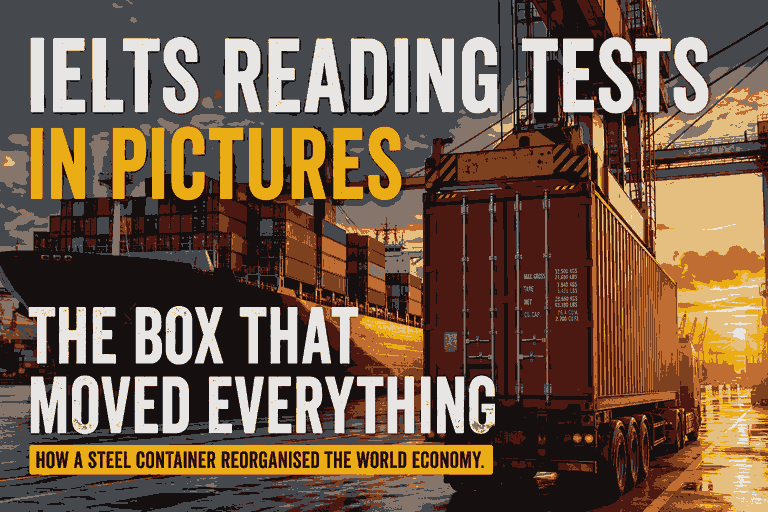
The Box That Moved Everything
How a steel container reorganised the world economy.
Before 1956, loading a ship was a task performed almost entirely by hand. Cargo arrived as barrels, sacks, crates and loose items of every shape, stowed piece by piece into the hold. A medium-sized vessel could take a week to load and another week to unload. During that time, the ship earned nothing.
Studies in the 1950s found that the cost of moving goods was dominated not by the ocean voyage, but by what happened at each end. Port handling accounted for a substantial majority of the total cost.
Malcolm McLean was not a shipping man. He owned a trucking company. He spent years watching his drivers wait at docks while their loads were unpacked and restowed. His insight was simple: the cargo did not need to be handled at all if the container could move between truck, train and ship unopened.
The industry’s response for a century had been to build faster ships, which addressed the smaller part of the problem.
The idea itself was not new. Various forms of container had been tried since the nineteenth century. But McLean pursued a version that previous attempts had avoided. A container is useful only if every port, every crane, every truck chassis and every ship is built to the same dimensions.
McLean’s company held patents on the corner fitting that allows containers to be lifted and locked together. He licensed those patents royalty-free so the design could become an industry standard. Giving away the patent made the system work.
The consequences at the ports were severe and immediate. Employment on the docks fell by a large proportion within two decades. The labour disputes that followed were long and bitter.
The system also relocated the ports. Old finger piers were useless. Traffic moved to new deep-water terminals with enough space to stack containers, often many miles from historic dock areas.
As handling costs collapsed, distance became less important. Goods could be made in one country for sale in another. Supply chains lengthened and subdivided. Economists rank containerisation alongside tariff reduction; some rank it above.
The system’s efficiency also concentrated its vulnerability. In 2021, a single vessel wedged across the Suez Canal halted a significant share of world trade for six days. The effects were felt for months.
A sealed container is opaque. Customs authorities cannot inspect more than a small percentage without stopping the flow. The same property that makes containers efficient also makes them convenient for moving things that should not be moved.
Scanning technology has improved, but the fundamental tension remains: inspection thorough enough to be completely reliable would remove the advantage the system exists to provide.
McLean’s invention brought efficiency, speed and lower costs. But it did more than improve shipping. It reorganised ports, labour, manufacturing and trade, turning a simple steel box into one of the hidden foundations of the modern world economy.
Now it’s time to try your knowledge with advanced IELTS Reading test about Malcolm McLean
Turn this lesson into real IELTS progress
Take a free IELTS practice test or unlock premium writing feedback to improve your score faster.