Cambridge IELTS Test Book 20 – Success Formula
This is the brief on IELTS 20 Academic.This book is a collection of four authentic practice tests from Cambridge that perfectly replicates the real exam, proving exactly why it is the ultimate blueprint for busy candidates who want to pass.First, let's talk about the steepest hurdles.reading passage 3 with its complex scientific and philosophical arguments requiring high-level inference, and writing task 2's abstract arguments.To pass, you absolutely need 10 specific C1 and C2 words.Vulnerable, exacerbate, intrinsic,precarious, sustainable, autonomous, dissenting, plausible, succumb, and mitigation.Think of these 10 words not just as vocabulary, but as a heavy-duty toolkit needed to dismantle complex arguments.Second, we need to look at the structural glue holding everything together, which is the passive voice.It's critical for reading and for writing task one process diagrams, like making bamboo fabric, where the focus has to be on the object being acted upon.Why do examiners penalize R-cutting?Because in academic processes, what is happening matters infinitely more than who is doing it.Finally, beware of the careless traps that will sink your score.So watch out for these five key pitfalls.One, omitting a clear overview in task one.Two, repetitive vocabulary, like overusing the noun zone.Three, basic spelling errors, like writing typical or important.Four, inaccurate data reporting, like giving wrong numbers or false comparisons.And 5, inconsistent tense use, like using the present tense for past historical data.You might think a brilliant argument hides bad spelling, but it doesn't.Basic slips distract the examiner and immediately drag down your lexical resource score.Ultimately, wielding advanced vocabulary, mastering the passive voice, and dodging basic formatting errors is the ultimate formula for acing the exam.
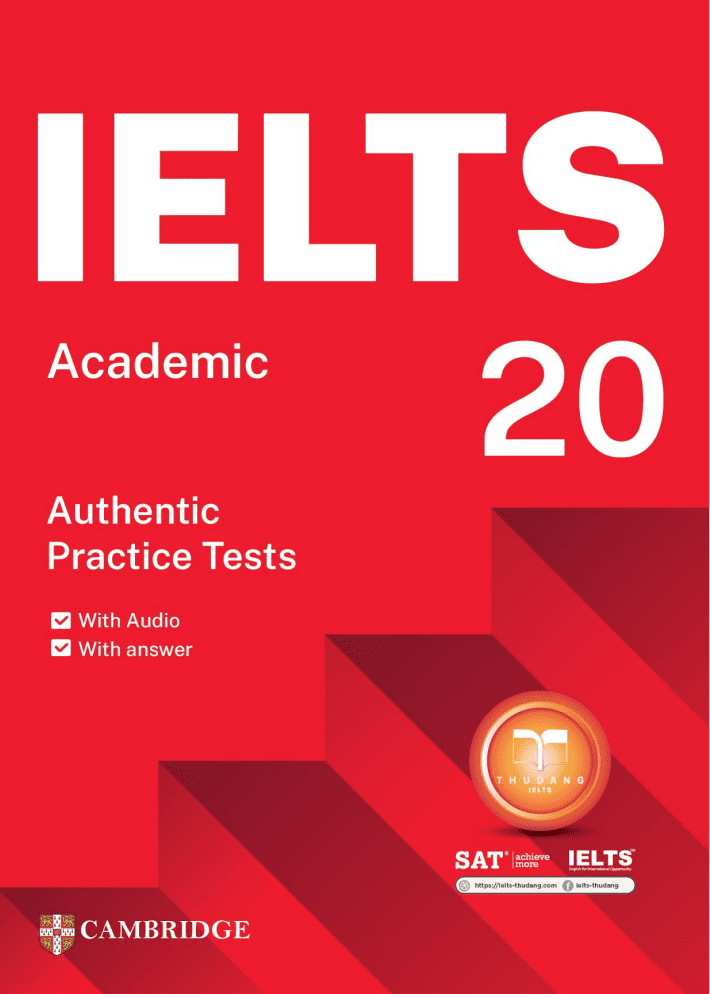
IELTS 20 Academic is a collection of four authentic practice tests from Cambridge University Press & Assessment that provide candidates with the opportunity to practice using materials that exactly replicate the real exam. It includes tests for Listening, Reading, Writing, and Speaking, complete with answer keys, audio scripts, and sample writing answers with examiner comments.
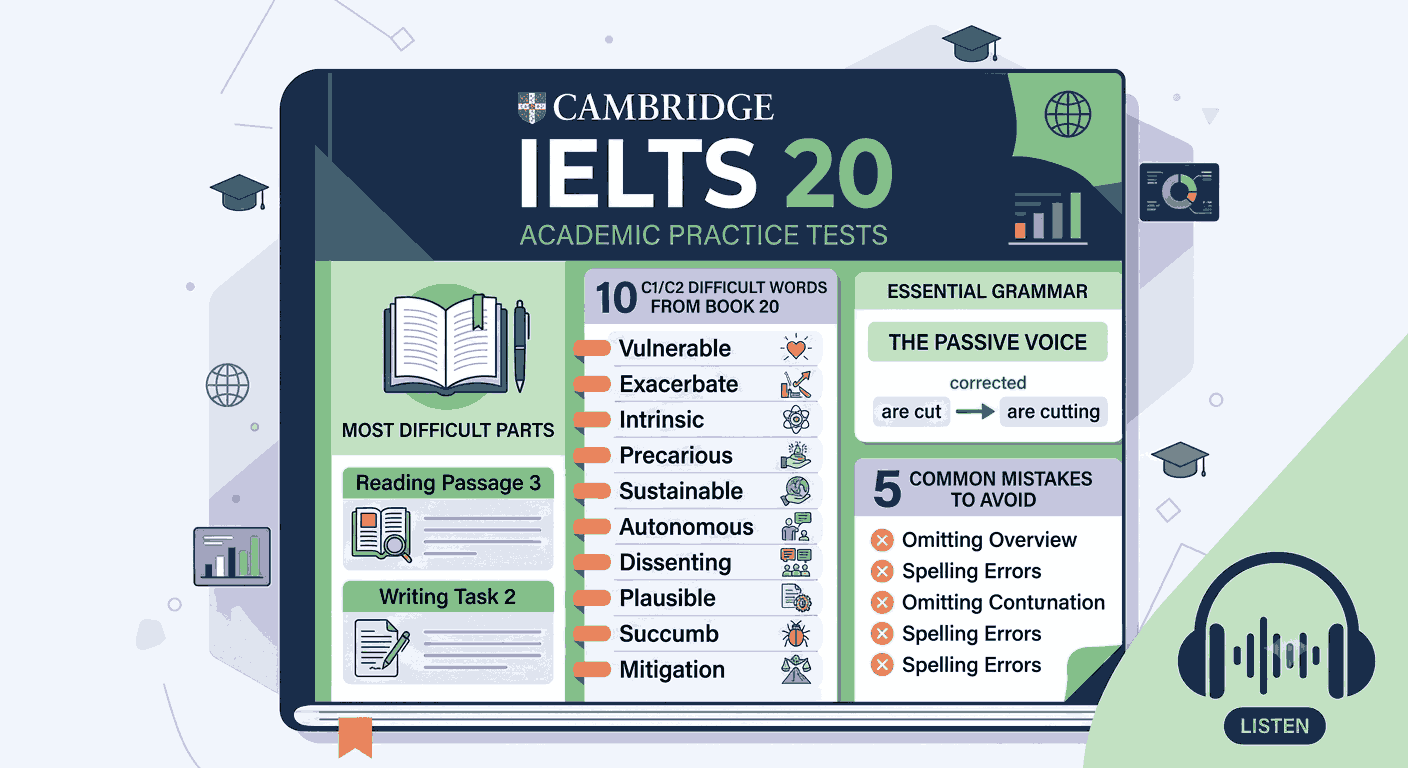
The Most Difficult Part of the Exam
While difficulty is subjective, Reading Passage 3 and Writing Task 2 are generally considered the most challenging.
- Reading Passage 3: These texts (such as “How stress affects our judgement” or “Robots and us”) involve complex scientific or philosophical arguments, requiring a high level of inference and the ability to distinguish between different experts’ views.
- Writing Task 2: Candidates must construct a well-developed argument on abstract topics (e.g., the environmental impact of flying or global fashion trends) using advanced vocabulary and varied grammatical structures.
10 C1/C2 Difficult Words Used in the Cambridge IELTS Test Book 20
These advanced words appear across various tests in the book:
- Vulnerable: Exposed to the possibility of being attacked or harmed (used regarding kākāpō chicks and climate-affected neighborhoods).
- Exacerbate: To make a problem or bad situation worse (used regarding coastal erosion in Indonesia).
- Intrinsic: Belonging naturally; essential (used regarding the nature of machines).
- Precarious: Not securely held or in position; dangerously likely to fall or collapse (used regarding the survival of elm trees).
- Sustainable: Able to be maintained at a certain rate or level; environmentally friendly (used regarding energy and food production).
- Autonomous: Having the freedom to govern itself or control its own affairs (used regarding the perceived threat of AI).
- Dissenting: Holding or expressing opinions that are at variance with those previously or commonly held (used regarding attitudes toward robot umpires).
- Plausible: Seeming reasonable or probable (used to describe explanations for loneliness).
- Succumb: To fail to resist pressure, temptation, or some other negative force (used regarding trees dying from disease).
- Mitigation: The action of reducing the severity or seriousness of something (used regarding climate change strategies).
Find these words on free EXAM page and include them in your Leitner and practice everyday.
Essential Grammar for the Cambridge IELTS Test Book 20: The Passive Voice
To pass the Writing Task 1 (Process Diagram) and Reading sections successfully, you must master the passive voice.
- Why it’s important: In describing processes (like “How bamboo fabric is made”), the focus is on the object being acted upon, not the person doing it.
- Correction Example: An examiner noted that a candidate lost marks for using the active “are cutting” when the passive “are cut” or “are crushed” was required to describe how bamboo stems are processed.
5 Common Mistakes to Avoid in the Cambridge IELTS Test Book 20
Based on examiner comments provided in the sources, candidates should avoid these pitfalls:
- Omitting an Overview: In Writing Task 1, failing to provide a clear summary of the main features or stages will significantly lower your score.
- Repetitive Vocabulary: Using the same cohesive devices (like “on the other hand”) or the same nouns (like “zone”) repeatedly indicates a limited range.
- Spelling Errors: Even with strong ideas, basic spelling mistakes (e.g., “tipycal,” “dicreased,” “importent”) distract the reader and reduce the Lexical Resource score.
- Inaccurate Data Reporting: Reporting the wrong numbers or making false comparisons between data points (e.g., misstating population changes in New York districts) hurts Task Achievement.
- Inconsistent Tense Use: Candidates often mistakenly use the present tense to describe historical data (e.g., library loans from 2007–2016) instead of the required past tense.
Practice Cambridge IELTS Tests Book 20
Cambridge IELTS Academic 20 Listening Test 1 – Full
Start test →
Cambridge IELTS Test 20 Reading Test 4 – FULL
Start test →Cambridge IELTS Test 20 Reading Test 3 – FULL
Start test →Cambridge IELTS Test 20 Reading Test 2 – FULL
Start test →Cambridge IELTS Test 20 Reading Test 1 – Full
Start test →
Cambridge IELTS Book 20 Test 4 Writing – FULL
Start test →Cambridge IELTS Book 20 Test 3 Writing – FULL
Start test →Cambridge IELTS Book 20 Test 2 Writing – FULL
Start test →Cambridge IELTS Book 20 Test 1 Writing – FULL
Start test →Turn this lesson into real IELTS progress
Take a free IELTS practice test or unlock premium writing feedback to improve your score faster.