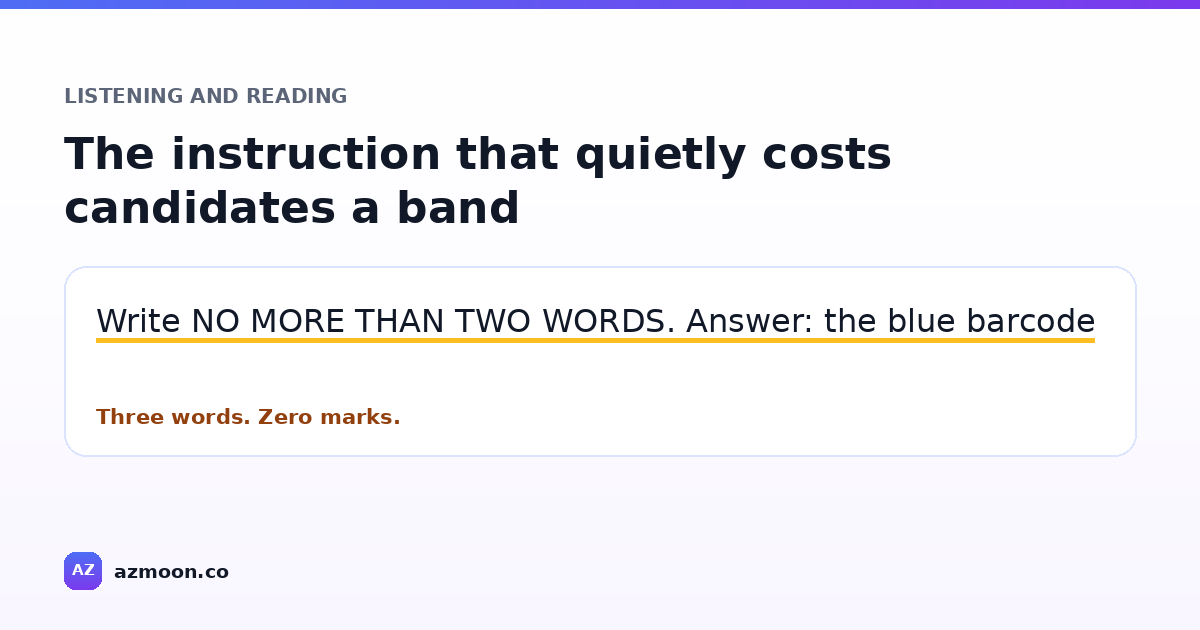
You hear the answer. You write it down. You get zero marks.
Not because you misheard — because you wrote three words where the instruction allowed two. In Listening and Reading, where every mark is one point of forty, a handful of these is the difference between 6.5 and 7.
What counts as a word
The rules are precise and almost nobody is taught them:
Hyphenated words count as one. Well-known is one word. So is twenty-five.
Numbers written as digits count as one, however long. 1985 is one word.
£450 is one word.
Articles count. The blue folder is three words. If the limit is two, you write blue folder — and it is still correct, because the article was never part of the answer.
Contractions count as one. Doesn’t is one word.
The mistake that is not about words at all
Here is the version that catches strong candidates.
The instruction says ONE WORD ONLY. The answer is a number. You write twenty five because you heard it spoken.
That is two words. Zero marks — for an answer you got completely right.
Under a ONE-WORD rubric, a number must be written in digits. Always. 25, not twenty-five, and certainly not twenty five.
This one rule is worth checking on every numerical answer you write, and it
takes two seconds.
Where the marks actually go
In our own test writing we caught this three separate times before it became a formal rule, and we were writing the answers deliberately. Candidates under time pressure, listening once, have no chance unless the habit is automatic.
The most common losses, in order:
- Copying too much from the recording. You hear “she left it in the blue folder on the desk” and write blue folder on the desk. The answer was blue folder.
- Spelled-out numbers under a one-word limit.
- Adding an article that pushes a two-word answer to three.
- Adding a unit that was already printed on the question paper. If the gap reads “__ kilograms”, writing 40 kilograms is two words where one was needed.
How to make it automatic
Read the instruction before the audio starts, and say the number to yourself. “Two.” Then you are counting as you write rather than afterwards.
Write the shortest thing that answers the question. If you are unsure whether a word belongs, remove it and read the sentence back. If it still answers, it did not belong.
Check every numerical answer for digits. This is the single highest-value ten seconds in the transfer time.
Never add a unit that is already printed. Look at the gap, not just the audio.
The good news
This is the easiest category of marks to recover, because it requires no improvement in your English at all. Your listening is already good enough. The marks are being lost after you have understood everything — in the writing down.
Fixing it is worth more, faster, than any amount of vocabulary study.
Every Azmoon Listening and Reading test flags which kind of mistake cost you each mark, including this one. Try one free.
Turn this lesson into real IELTS progress
Take a free IELTS practice test or unlock premium writing feedback to improve your score faster.